
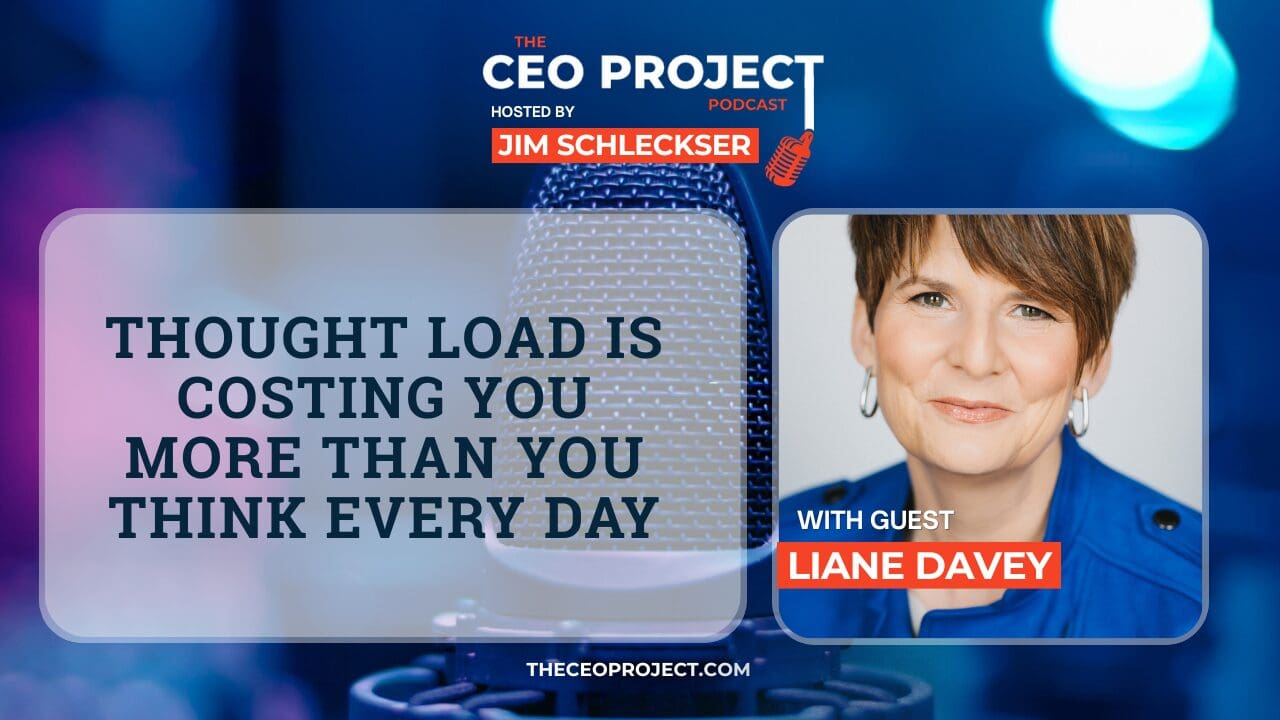




What if your workload isn’t actually the reason you’re overwhelmed? The real problem may be your thought load.
CEOs can spend an entire day moving from meeting to meeting, making decisions, switching between priorities, and managing other people’s problems, yet still wonder what they actually accomplished. In this episode, Jim Schleckser talks with teamwork expert and author Liane Davey about thought load, the invisible combination of cognitive demands, emotional burdens, and depleted energy that’s quietly undermining leadership performance.
By listening to this episode, you’ll learn how to:
- Recognize the difference between workload and thought load and identify what’s actually draining your capacity.
- Reduce unnecessary meetings, distractions, decision fatigue, and emotional burdens that prevent you from focusing on your most important work.
- Use a practical framework to decide what to delete, delay, distribute, or diminish so you can spend more time where you provide unique value as a CEO.
Listen now to learn how to manage your thought load, reclaim your attention and energy, and create the space you and your team need to do your best work.
Understanding and Managing Thought Load
00:00 | Why Being Busy Doesn’t Mean You’re Making Progress.
Jim Schleckser welcomes Liane Davey, author of Thought Load, to explore why leaders can have packed calendars and busy minds yet still struggle to make meaningful progress on their most important priorities.
05:35 | It’s Not Your Workload, It’s Your Thought Load.
Liane introduces thought load as the invisible tax on performance created by rising cognitive demands, emotional burdens, and depleted energy reserves, explaining why reducing workload alone may not solve overwhelm.
10:15 | Why Some Leaders Handle More Than Others.
Individual capacity matters, but so do habits. Liane explains how sleep, focus, mindfulness, emotional processing, and energy management can dramatically change how much pressure a leader can sustainably handle.
14:45 | The Hidden Cost of Too Many Meetings.
The average manager spends hours each week in meetings with different people, priorities, and dynamics. That constant switching creates cognitive and emotional demands that significantly increase thought load.
19:40 | Shrink Your Teams and Strengthen Your Communities.
Instead of putting everyone on every project, Liane recommends creating small teams of truly interdependent people, supported by a broader community that can contribute expertise when needed.
Helping Leaders and Teams Do Their Best Work
23:50 | When Feedback Becomes a Weapon.
Feedback is supposed to promote learning, but poorly delivered feedback can feel like judgment. Liane explains why that triggers self-protection rather than curiosity and can add another emotional burden to the workplace.
28:05 | Put Your Own Oxygen Mask on First.
Before trying to reduce your team’s thought load, leaders need to manage their own. That starts with getting clear on the outcomes that matter most, improving emotional awareness, and protecting renewable energy sources.
32:10 | Discover Your Overwhelm Style.
Liane describes four ways people tend to respond when overwhelmed: whirlwind, stickler, brooder, and rogue. Understanding your pattern can help you identify what restores your energy and how your behavior affects the rest of your team.
36:15 | Decide What Deserves Your Attention.
Sometimes simply having language for thought load can change behavior. Liane encourages leaders to become more deliberate about what they allow into their minds and what can wait.
38:45 | Delete, Delay, Distribute or Diminish.
Liane closes with a practical framework for reclaiming a CEO’s time: ask whether something is important, urgent, uniquely yours, and entirely essential. The answers reveal what you can delete, delay, distribute to someone else, or diminish to the highest-value work.
About Liane Davey
Liane Davey has spent more than 25 years researching and advising teams on how to perform at their best. Known as the “teamwork doctor,” she works with teams from the frontlines to the boardroom, across industries and around the world, from Boston to Bangkok. Through her work with hundreds of teams, including 26 Global Fortune 500 companies (and counting), she has developed a practical, research-backed approach to solving the challenges that prevent teams from working effectively together.
Liane is a New York Times bestselling author of You First: Inspire Your Team to Grow Up, Get Along, and Get Stuff Done and The Good Fight: Use Productive Conflict to Get Your Team and Organization Back on Track. She is a regular contributor to Harvard Business Review and a sought-after expert for media outlets including CNN, NPR, USA Today, The Globe & Mail, and Forbes. Her work focuses on increasing productivity, strengthening engagement, developing leaders, and helping teams navigate conflict in healthier, more effective ways.