
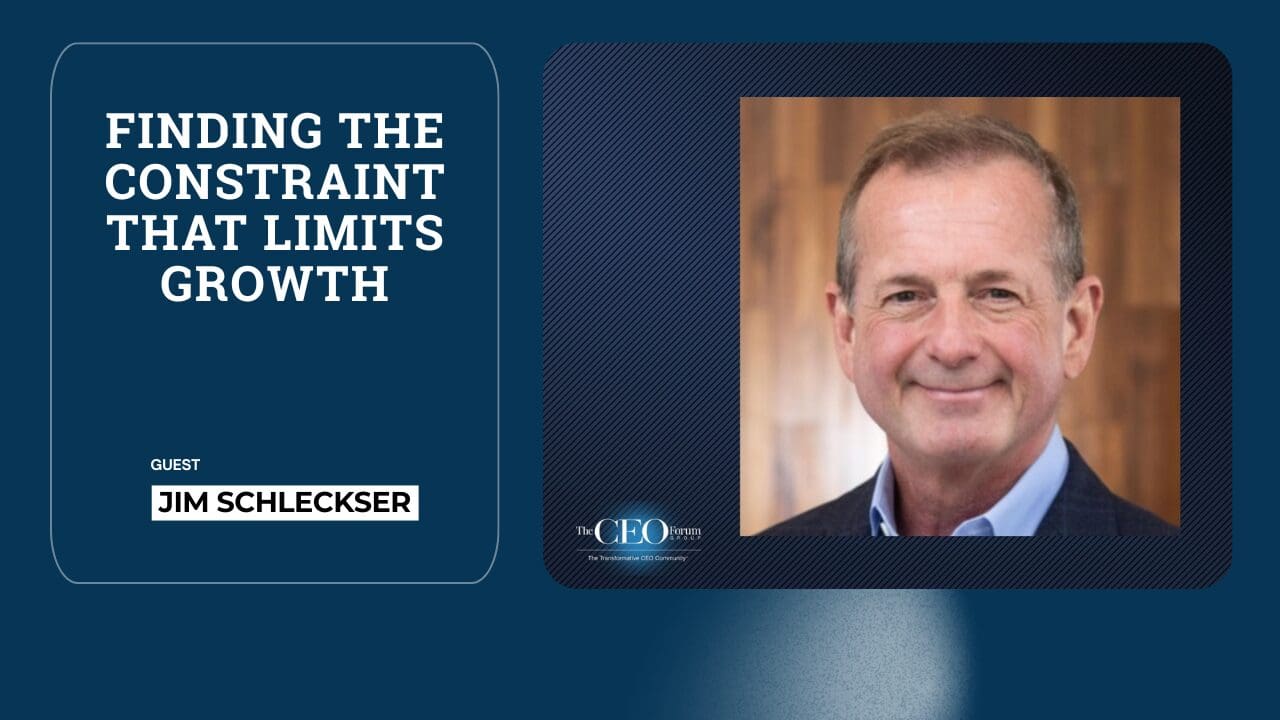
Finding the Constraint That Limits Growth – Episode Summary
What separates incremental growth from transformational growth? According to Dr. Jim Schleckser, founder and CEO of The CEO Project, it begins with identifying the single constraint that is limiting the performance of the entire business, and then giving that issue the CEO’s focused attention.
In this conversation with Robert Reiss on The CEO Show, Jim explains how The CEO Project brings together CEOs of similarly sized, noncompeting companies in confidential peer groups. Using a case-study approach, members examine the most pressing constraint in each business and draw on perspectives from leaders outside their own industries. That outside perspective can expose assumptions, unlock breakthrough ideas, and give CEOs the confidence to make difficult decisions.
Jim shares the story of one CEO who exited an unprofitable business line, concentrated on a stronger strategic consulting model, and ultimately sold the company for $300 million. He also discusses why CEOs should spend 15 to 20 hours each week addressing their most important constraint, how the “70% rule” makes delegation easier, and why a company’s limiting factor usually falls into one of three areas: its business model, talent, or processes and systems.
The discussion also explores the five hats effective CEOs wear, the leadership lessons Jim learned from a failed business-model transition, and the importance of pacing yourself through long-term challenges. His experience climbing Mount Kilimanjaro reinforces a simple but powerful lesson: meaningful progress often comes from moving steadily enough to finish.
Ultimately, Jim argues that CEOs are never finished products. Leadership is an ongoing project, and better CEO decisions create stronger companies, more secure jobs, and a wider positive impact.
Key Takeaways
- Every business has a constraint that governs the performance of the entire system.
- CEOs should devote 15 to 20 hours each week to finding or fixing the company’s most important constraint.
- A constraint generally resides in one of three areas: the business model, talent, or processes and systems.
- Outside-industry perspectives can challenge assumptions and generate breakthrough thinking.
- If someone can complete a task 70% as well as the CEO, it should usually be delegated with the appropriate level of oversight.
- CEOs use the learner and player hats to find constraints, then the architect, coach, or engineer hat to address them.
- Long-term leadership requires disciplined pacing: “pole pole,” or “slowly, slowly.”
Full Transcript
(This transcript has been lightly edited for clarity and readability.)
Robert Reiss: Hello, America. Robert Reiss here, and we’re joined today by Jim Schleckser. How are you, Jim?
Jim Schleckser: I’m well. Thanks, Robert.
Robert: You will love hearing what Jim does because he is the founder and CEO of The CEO Project. It has a unique model that helps midsize companies, usually from $50 million to perhaps $3 billion, grow significantly and plan their exits. They have an incredible track record, and it’s a different model from anything I had heard about before. Explain exactly what the model is.
Jim: We work with CEOs of larger companies, from $50 million to a few billion dollars, and put them into peer groups whose members lead companies of similar size and complexity. There are about eight CEOs in each group. They meet quarterly, and there are no competitors in the same group.
We think that is important because breakthrough thinking doesn’t come from inside your industry; it comes from outside your industry. Somebody looking at your problem might ask, “Why do you think about it that way, Robert? Why don’t you think about it this other way?” You realize it’s a great idea, and suddenly you have a breakthrough concept.
That’s the model. We work with about 100 CEOs. When you run a larger company, it is difficult to find a peer group whose members truly understand what you are going through and the complexities you face.
Very few people are highly successful above a certain company size unless they build some infrastructure around themselves. A peer group is a great way to do that. Some people compare it to an advisory board, but an advisory board requires more logistics, more time, and, frankly, more expense. This is a high-quality way to gain that support.
Robert: Jim, we have about 600,000 listeners, most of them CEOs who are trying to determine how to grow their companies significantly not a little bit, but geometrically. What is the secret?
Jim: The secret is the theory of constraints. In any system you can name, there is something that controls the performance of the entire system. Think of a garden hose: if there is a kink in it, that kink controls how much water comes out of the end. Our job is to find the kink and open it up.
That is exactly what CEOs should be doing in their businesses. It is our job to identify the point of constraint, the kink in the hose, and then open it up.
When we talk to CEOs, about half know where their point of constraint is. We also tell them they need to spend a significant amount of time finding and fixing it. Only about half of those who know the constraint actually devote significant time to it. If you know your constraint and are spending time addressing it, you are in the top 25% of CEOs. I can almost assure you that will produce growth over time.
Robert: What is an example of a company and the challenge it faced?
Jim: I have a call later today with one of our members, whom I have worked with for more than a decade. He had two business lines. One organized high-level travel for sales and executive groups, including hotels, content, and other logistics. The other was a consulting business that helped pharmaceutical companies with marketing.
Over time, most of his employees worked on the travel side, yet that side made no money. The service had been sent to purchasing, and the price point had been compressed repeatedly. Meanwhile, he was making money on the consulting side with a much smaller group.
He brought the issue to his CEO peer group, and they told him, “It’s a difficult decision, but you need to get out of the travel business.” He thought about it, and one quarter later he said, “I’m out.”
A large pharmaceutical client then asked him to bid on a major conference. He said, “No, I’m not going to bid on it. I’m out of that business.” They replied, “No, we’re serious. We really want you to do this.” He told them, “So am I. I’m not bidding on it. I’m done.”
He had to lay off more than 100 people and shrink the company. He then grew from the stronger base of a much better business model. The travel operation was a poor model; strategic consulting was a better one. He expanded that business over several years and, just last month, sold the entire company for $300 million. He achieved an extraordinary result because of one incredibly difficult but important decision.
Robert: Congratulations to him for having the fortitude—and congratulations to you for helping put him in the right environment to see it. I hope your model gives you a piece of the action, perhaps 100 basis points or something like that.
Jim: You’re supposed to tip your waiter 20%, you know!
Robert: I know.
Jim: Unfortunately, no. It is a membership model. People pay annually to be members, and that is our only compensation.
Robert: There are many people working in the CEO space and offering different services. I’m only in media; I don’t do any consulting whatsoever. How do you differentiate The CEO Project in this crowded field?
Jim: It is literally the Wild West. Anybody can hang up a shingle and say, “I’m a CEO coach,” even if they don’t have the background to do the job.
First, everything we do is based on the theory of constraints, so it has a strong theoretical foundation. It isn’t simply a collection of tools or things we have learned.
Second, all our advisors are former CEOs. They have sat in the seat. When we build a peer group of leaders from companies with similar size and complexity, the advisor will have run a company in or around that size. The advisor truly understands the challenges, has occupied the role, and has dealt with many of the same problems.
Robert: Are you saying all the advisors have run companies worth more than $500 million—perhaps up to $1 billion?
Jim: Not all of them. One ran a $300 million company, and another ran a somewhat smaller one. But our advisors have run companies ranging up to a few billion dollars. We aren’t assigning someone whose experience is limited to a $20 million company to advise a CEO running a much larger operation. It is a very different model. Our advisors have substantial relevant experience.
Third, our quarterly meetings use a case-study methodology because the groups are regional rather than local. Instead of bringing in an outside speaker to discuss a subject that may or may not be important to a member at that moment, we work much like an MBA program. You identify the point of constraint in your business, write it up, and bring it to the group. The members then process it with you and offer ideas for breaking through that constraint.
That is extremely powerful because it addresses an urgent issue. Solving it could be worth millions of dollars, and you have eight smart people helping you crack the problem and move to the next level.
It also develops the CEO. You receive immediate, actionable guidance for your own challenge, but you learn from everyone else’s cases as well. If Robert has a problem with sales compensation, for example, I may realize I have the same problem and didn’t even know it. I can learn from his case, too.
Robert: Do members remain with the same group for a long time?
Jim: Most of our clients stay for seven or eight years—and often longer. The number-one reason they leave is that they sold their business for a large amount of money. The second is retirement. They stay a long time, and we like to think that’s because the model works.
Robert: One challenge many CEOs face is delegation. Would you introduce your thoughts on that before we take a break?
Jim: Absolutely. Delegation becomes important when we tell CEOs they need to spend substantial time finding and fixing their point of constraint. They respond, “I’m already working 70 hours a week. How do I do that?”
There is a methodology. My first book was called Great CEOs Are Lazy, which addresses how to reduce the number of hours required to achieve a great result. The answer is to spend 15 to 20 hours a week on the point of constraint. Everything else has to fit into the remaining time.
You do that by deferring something—pushing it into the future and not dealing with it now—delegating it, or simply deciding not to do it and crossing it off the list.
Delegation is the difficult one for CEOs because we compare ourselves with the person receiving the assignment. If I have a task I want to delegate, I might think, “Bill isn’t quite as good at this as I am.” That is the wrong comparison. If you are a CEO, you have certain gifts. You are exceptional in some way, or you would not have the job.
We tell CEOs that if someone is 70% as good as they are at a task, they should delegate it immediately. That is a powerful idea because the person doesn’t have to be as good as you; they only need to be 70% as good. Many people can meet that standard. CEOs can then become more aggressive about delegating work they should not have been doing in the first place, freeing time for more important issues such as the point of constraint.
Delegation does not necessarily mean handing over a task and never seeing it again. That is the highest level of delegation. At another level, you might say, “Investigate this, come back, and we’ll discuss it. I’ll make the decision.” Or you might say, “Investigate it and develop a plan. Tell me the plan, and if I agree, I’ll let you move forward.”
There are different levels of delegation depending on the risk and the amount of money involved. Delegation is not black and white; it contains many shades of gray. But the 70% rule gets you started.
Robert: That is so true. For someone who wants to grow a business dramatically and perhaps achieve a $300 million exit, where can they learn more about The CEO Project?
Jim: TheCEOProject.com is the perfect place to go.
Robert: When we return, we’ll hear about a transformative moment in Jim’s career. It may connect with the companies he ran before he founded The CEO Project. Stay tuned to learn more about growing your business.
Robert: Hi, this is Robert Reiss, back on The CEO Show, where we speak with CEOs who have reinvented the fabric of America. That is exactly what we’re doing with Jim, founder and CEO of The CEO Project. You occupy a unique space in the middle market, helping leaders find their points of constraint and significantly grow their businesses.
What personal transformative moment in your career helped elevate you?
Jim: Interestingly enough, it was a time when things did not go the right way. At one of the last companies I led, we sold into the telecommunications industry. It was clear that our technology was disappearing, and the technology replacing it did not require what we provided.
We identified a related technology that we intended to acquire, but the acquisition was ultimately stopped for several reasons. The board would not allow us to proceed. That was a giant mistake. When a business model is dying, you have to jump to another business model. We discuss that at The CEO Project, as in the example I shared earlier, but I was not able to make the change in that company.
After I left, the company shrank materially because it failed to make the necessary adjustments. The leaders did not want to face the reality that the market had shifted and the company needed to move with it.
When we discuss points of constraint, the business model is one of the biggest. If you have a great business model, growing the business is much easier than it is with a difficult model. Ours was disappearing. We needed a new one, and we did not make the transition. It was an impactful lesson because I could see what needed to happen and wanted to do it, but I wasn’t enabled to proceed.
Robert: Some of your best lessons come from mistakes. You think, “I’m not making that mistake again,” and then you dig in more deeply because the experience was so painful.
Jim: Exactly. Return to the story of the CEO who sold his business for $300 million. It was a very similar situation: if you have a bad business model, get out of it and focus on the good one. I wish we had done that.
Robert: What first step should a CEO take when the business is doing fine, but the leader knows it has more potential? You can’t say, “Hire The CEO Project,” even if that might be the right answer.
Jim: That situation implies there is a point of constraint somewhere. When we discuss constraints, we talk about five hats a CEO should wear.
Two hats help you find the constraint. The first is the analyst, or learner, hat. Look at the reports and metrics, talk with other people, and read books to understand what may be getting in your way. The best CEOs are always curious.
The second is the player hat. Dive in and become involved in the process you suspect is a problem. You will figure it out. If you had a call center that you thought was underperforming, for example, you could work there for half a day. I guarantee a good CEO would emerge with 10 pages of notes about what should change.
The learner and player hats help you find the point of constraint. That constraint will lie in one of three areas: the business model, talent, or the processes and systems used to run the business. That’s it—just those three.
When working on the business model, the CEO wears the architect hat. That is what we did with the business that eventually sold for $300 million. It had a business-model problem. The people were good, and the processes were fine, but the business model was poor and had to change.
The second area is talent. Here the CEO wears the coach hat and focuses on acquiring, developing, and retaining great talent, particularly in the most important areas of the company. I always say talent is too important to delegate to HR. CEOs must be personally involved in recruiting senior talent. High performers will want to talk to the CEO when they can, so the CEO is part of bringing those people into the business.
The final area is processes and systems, where the CEO wears the engineer hat. These include IT and standard operating procedures, but they also include company values. Values tell people what to do when the rules don’t apply. If a company is always customer-first, always ethical, or guided by another core principle, employees can test a decision against that value and make the right choice 95% of the time. Values are an important part of the system.
Robert: That’s interesting. When you mentioned talent, I thought of a conversation with David Novak, cofounder and former CEO of Yum! Brands, which includes KFC, Pizza Hut, and Taco Bell. He said one secret to evaluating talent was always having dinner with the candidate’s partner. You learn a great deal, and unraveling a hiring mistake is a nightmare.
Jim: It’s expensive—really expensive. At the senior level, it could be a multimillion-dollar bad decision.
Robert: It can affect clients, reputation, and everything that follows.
I’m also curious about the name The CEO Project. Does it mean the CEO’s project is to find the point of constraint? How did you choose the name?
Jim: I’m not sure we were quite that thoughtful when we created the name. But after living with it for a while, I would say that all CEOs are projects. If you think you are the finished product, you aren’t. You can always improve.
We help leaders with the process of becoming even better CEOs. That is where the meaning of the name has landed for me.
Robert: On a personal level, you climbed a very tall mountain—Kilimanjaro. What did you learn about leadership from that experience?
Jim: I climbed Kilimanjaro a few years ago. It is 19,341 feet high, although you don’t need ice axes or technical climbing equipment; you hike up.
At the beginning, the guides repeatedly used a Swahili phrase: “pole pole,” which means “slowly, slowly.” On the first day, we were only at 8,000 feet. We were fit, excited, and ready to run up the trail. The guides kept saying, “Pole pole.” We put one foot in front of the other very slowly, thinking, “I could be moving so much faster.” And they would repeat, “Pole pole.”
As we climbed higher, they continued to say the same thing. I still felt great. But on the last day, with so little air, “pole pole” felt fairly fast.
That pace allows you to finish a long race. I used to run marathons, and the people who failed to finish often started very fast, then crashed and burned before the end. When you are undertaking a long project, the key is to pace yourself. Don’t move too quickly at the beginning, or you may run out of energy before the finish.
Robert: That is a great lesson. Our final question is: What is the future of The CEO Project?
Jim: We have a goal of positively impacting one million lives.
Robert: Wow.
Jim: It is a big goal. We are generous in spirit and want to make a difference in the world. We do that by helping CEOs make great decisions and build great companies so people have secure jobs, can buy a pickup truck, send their children to college, or accomplish whatever matters to them.
The CEO’s impact is material. Research indicates that 35% to 40% of a company’s outcome can be attributed to the CEO, so we have identified an important influence point.
With the approximately 100 CEOs we serve today, we affect around 400,000 people each year through the quality decisions we help those leaders make. If we more than double that impact, we will reach our goal of one million people. We would probably raise the target to two million after that, but first we’re working toward the one-million-person goal.
Robert: That is terrific. I wish you continued success. Again, visit TheCEOProject.com to learn more. It has been a pleasure having you on The CEO Show.
Jim: Thank you, Robert. It was great.
The Questions Every CEO Eventually Faces
Straight answers from decades of coaching CEOs leading growth companies from strategy and leadership to enterprise value, acquisitions, and CEO peer groups.
Get Answers Now
Unsure if The CEO Project Is Right for You?
Identify the leadership constraint having the greatest impact on your business.
Take our free 5-minute CEO Constraints Assessment and discover where to focus first.
Take the Assessment
Confidential conversations. Trusted peer perspectives. Better executive decisions.


