








Is your company’s “AI disruption” happening with you—or quietly without you… and putting your business worth at risk?
If you’re leading a mid-to-large company right now, you’re probably feeling two pressures at the same time: move faster with AI and don’t blow up the business while you do it. Because AI isn’t a future trend anymore—it’s already being built, tested, and used across departments, geographies, and teams (often without a single unified view). And that creates a real leadership headache: how do you scale AI for competitive advantage while still keeping guardrails in place?
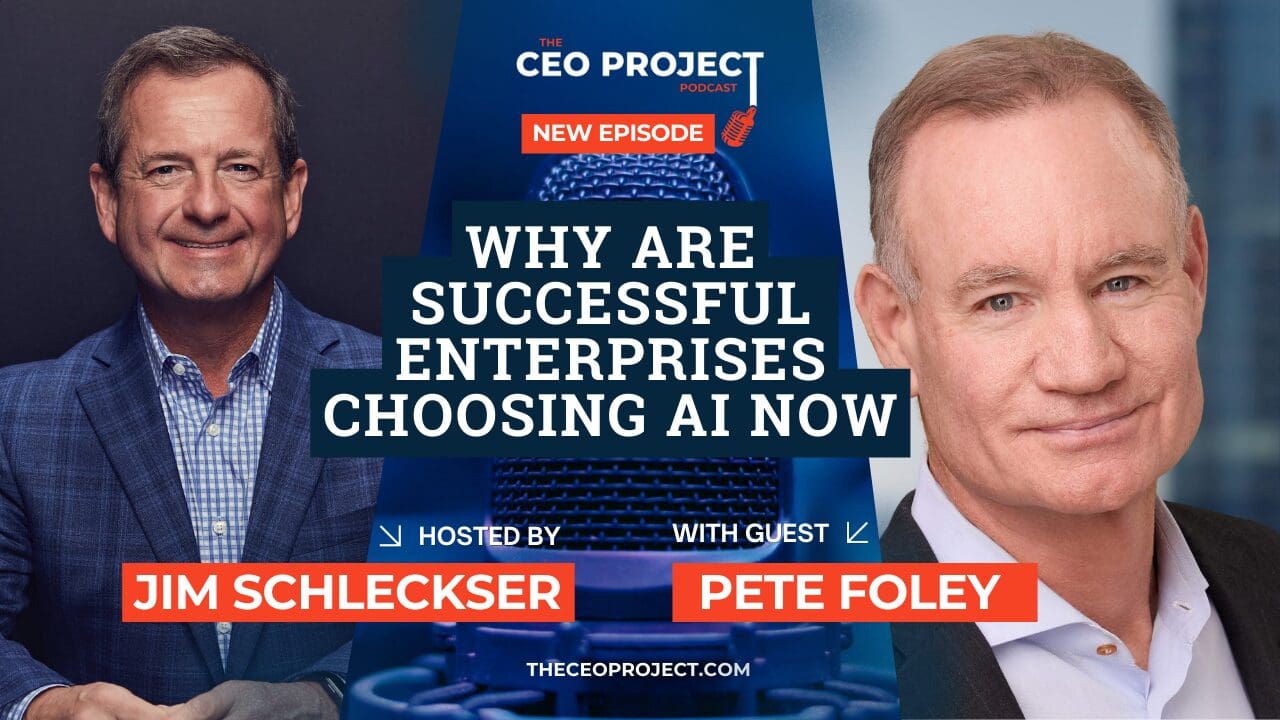
In this episode, Jim Schleckser talks with Pete Foley (CEO of ModelOp) about what happens when AI spreads “like wildfire” inside an organization—and how to regain control without killing momentum.
You’ll walk away with:
-
A practical way to get visibility into AI across your organization so you know what models exist, what they’re doing, and where the biggest risks are hiding.
-
A framework for putting governance and guardrails in place without slowing innovation—so you can move faster than competitors and sleep at night.
-
A clearer path to scaling AI investments into real business outcomes (revenue, cost reduction, risk control) instead of letting models sit stuck in limbo for 9–12 months.
Hit play now to learn how to build AI guardrails that protect your brand and accelerate results—so you can boost business worth before the market decides who survives the disruption.
AI Disruption Starts Faster Than Your Guardrails
[00:00] Jim Schleckser opens the episode by setting the tone: AI isn’t just a trend—it’s a business shift that will separate companies who adapt from those who get left behind.
[02:10] He lays out the “two kinds of companies” reality: the ones embracing AI now, and the ones that won’t survive the next few years because they waited too long.
[05:00] Jim introduces the core CEO problem: if AI adoption spreads inside your company like wildfire, how do you keep visibility and control without crushing innovation?
[07:30] Pete Foley explains how ModelOp began—by helping large enterprises build models and realizing the real issue wasn’t building AI…it was getting it into production.
[10:45] Pete breaks down why AI models can take 9–12 months to deploy in enterprise environments—and why that slow cycle becomes a competitive risk during AI disruption.
How to Scale AI Without Blowing Up the Business
[14:20] The conversation shifts to what leadership really needs: a way to manage AI across the entire organization—not just one department or one use case.
[17:15] Pete explains the first priority: visibility. Before you can govern anything, you need an inventory of what models exist, who owns them, and what business impact they touch.
[19:40] AI disruption gets more dangerous when every team builds its own models—because without oversight, risk can spread faster than your ability to respond.
[23:30] Pete introduces the “air traffic controller” analogy: you need a system that tracks every “plane” (model), enforces policies, and monitors performance in real time.
[28:10] They talk about the board-level pressure: AI is now a governance issue as much as a technology issue—because the downside risk can be just as high-impact as the upside.
[33:05] The episode closes with a practical reminder: the smartest move is putting the “tracks” down early—because waiting until you’ve lost control during AI disruption is usually too late.
About Pete Foley
With more than 25 years of executive and entrepreneurial experience in enterprise software and a track record of successful business exits, Pete Foley’s leadership gives ModelOp customers, partners and employees a high level of trust and confidence in the company and its future.
Prior to co-founding ModelOp, Pete held several chief executive roles, including CEO of RingCube Technologies, a desktop virtualization software solution provider acquired by Citrix in 2011; CEO of PortAuthority Technologies, a provider of data leak protection systems, from 2005 through its acquisition by Websense in 2007; and CEO of Infoblox (BLOX) from 2002 through 2005. In addition, Pete was the Executive Chairman of Graphite Systems, a low latency, flash-based big data appliance that was acquired by EMC, from 2012 to 2015.