
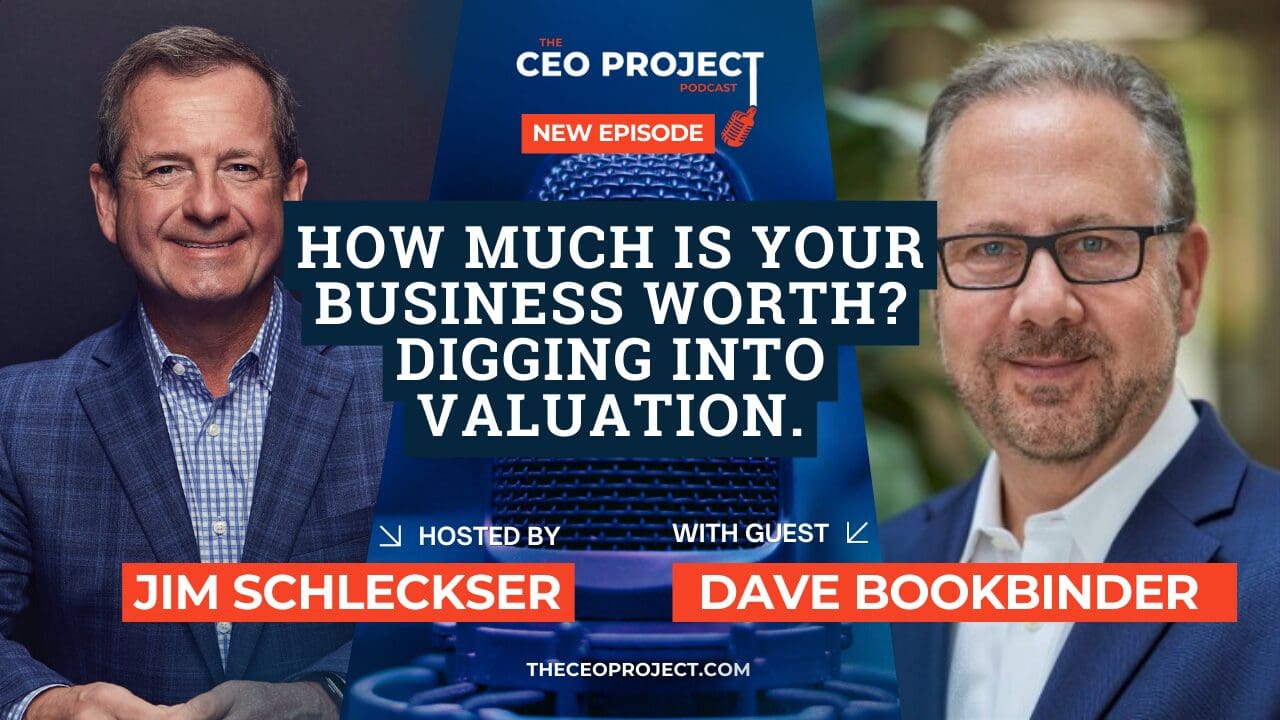








Ever catch yourself wondering, “What is my business worth—like, the real number, not the cocktail-party guess?”
If your business represents the majority of your net worth (and for most CEOs, it does), not knowing your true valuation is risky. You could be planning an exit, thinking about succession, considering a partnership change, or even just trying to make smarter growth decisions—but without a real valuation framework, you’re basically relying on back-of-the-napkin math. In this episode, you’ll get a clear, CEO-friendly breakdown of how valuations actually work and what drives value up (or quietly drags it down).
You’ll walk away with:
-
A practical understanding of the real valuation methods (market comps, public peer multiples, discounted cash flow, and when asset-based valuation applies) so you can stop guessing and start thinking like an investor.
-
A sharper perspective on what increases or decreases your company’s value—especially risk factors like customer concentration, shaky financials, key-person dependency, and unreliable forecasts.
-
A clearer playbook for “valuation readiness” so you can improve value before a buyer, a partner, or the IRS forces the question.
Press play now and steal the same valuation lens buyers use—so you can protect your wealth, reduce risk, and increase what your business is worth before the next big decision hits.
What Your Business Worth Really Is (And Why Most CEOs Get It Wrong)
00:00:00 — Welcome + Why valuation matters.
Jim opens with the question CEOs ask constantly: “How much is my business worth?”—because for many owners, the business represents most of their net worth.
00:01:15 — Meet Dave Bookbinder (valuation expert).
Jim introduces Dave’s background in corporate finance, valuation, intangible assets, and high-stakes business scenarios like acquisitions, estate planning, and shareholder disputes.
00:03:00 — The “cocktail napkin valuation” myth gets crushed.
Dave makes it clear: those back-of-the-napkin multiples you hear socially are not real valuation methods, and they create unrealistic expectations fast.
Valuation Methods Every CEO Should Understand
00:04:10 — Valuation approach #1: Market comps (transactions).
Dave explains how valuators look at recent industry transactions, derive multiples, and adjust for differences like profitability, growth, and size—just like real estate comps.
00:06:20 — Where private-company deal data comes from.
Jim asks how you find transaction data when private deals aren’t public. Dave explains that valuation firms use specialized databases most owners don’t have access to.
00:07:30 — Valuation approach #2: Public guideline company method.
Dave walks through building a “peer basket” of publicly traded companies to estimate value—then applying adjustments (including the private-company liquidity discount).
00:09:25 — Valuation approach #3: Discounted cash flow (DCF).
Dave emphasizes that valuation is forward-looking, and DCF often carries the most weight because it values the business based on the present value of future cash flows.
00:11:10 — The big question: how do you choose the discount rate?
They unpack how the risk-adjusted discount rate is built from mostly empirical data (beta, risk-free rate, equity risk premium), plus one subjective component: company-specific risk.
00:13:05 — The biggest valuation lever: reducing risk.
Dave explains the core idea: valuation is an assessment of risk and return, and anything you do to reduce risk (customer concentration, forecast uncertainty, dependence on one person) can raise value.
00:15:20 — When asset-based valuation is the right tool.
Dave explains when the asset approach matters, especially for asset-heavy businesses (like real estate) or distressed companies where balance sheets don’t match market reality.
00:17:10 — Why valuation methods produce different numbers.
Jim asks what happens when you get 3 different valuations. Dave explains that valuators correlate and weight methods based on reliability, and big gaps are a red flag.
00:19:10 — Valuing intangible assets (IP, patents, trademarks).
They shift into intangible asset valuation, which often comes down to estimating whether there’s an income stream, cost savings, or defensible market advantage tied to the asset.
00:20:35 — The “relief from royalty” method (a smart workaround).
Dave shares a method often used for trademarks/patents: valuing IP by estimating the royalties you don’t have to pay because you own it—based on real-world licensing rates.
00:23:10 — Partnership breakups: why valuation gets ugly.
They dive into business divorce scenarios where each side hires their own evaluator and perspectives conflict because each party wants a different future story (moonshot vs. meltdown).
00:26:00 — The “third evaluator” isn’t just splitting the difference.
Dave explains that the tie-breaker evaluator often reviews the first two reports and digs into the assumptions to find bias, advocacy, or unrealistic projections.
00:28:20 — Estate planning + wealth transfer valuation strategy.
They discuss gifting shares, trusts, and tax valuation goals, where owners often want the lowest defensible valuation—but Dave stresses integrity and IRS defensibility.
00:31:05 — Divorce cases and fraud risk.
They cover divorce valuation, emotional conflict, and “hide-the-ball” behavior like moving assets around—plus what can happen if the court forces a sale to settle value disputes.
00:34:10 — What happens when valuations go wrong.
Dave explains that a bad valuation can lead to audits, penalties, broken expectations in a sale process, or valuation whiplash during due diligence if the original story wasn’t realistic.
00:36:20 — The top value drivers CEOs can control.
Dave gives the big levers: clean, credible financials, reviewed/audited statements, quality of earnings, recurring revenue/contracts, forecast accuracy history, and reducing key-person risk.
00:39:10 — “If you got hit by a bus tomorrow…” test.
Dave shares a powerful moment: many owners realize their business wouldn’t survive them, so building leadership, documentation, systems, and succession plans can boost valuation.
00:41:00 — How to contact Dave + closing remarks.
Dave shares where to find him (LinkedIn + hfco.com), Jim praises the insights, and they close out with a reminder that valuation affects nearly every major CEO decision.
About Dave Bookbinder
Dave Bookbinder is a corporate finance executive with a focus on business and intangible asset valuation. Known as a collaborative consultant, Dave has served thousands of client companies of all sizes and industries.
Dave has conducted valuations of the securities and intangible assets of public and private companies for various purposes, including acquisition, divestiture, financial reporting, stock-based compensation, fairness and solvency opinions, reorganizations, recapitalizations, estate planning, and S-Corp. conversion, exit strategy, and succession planning.